
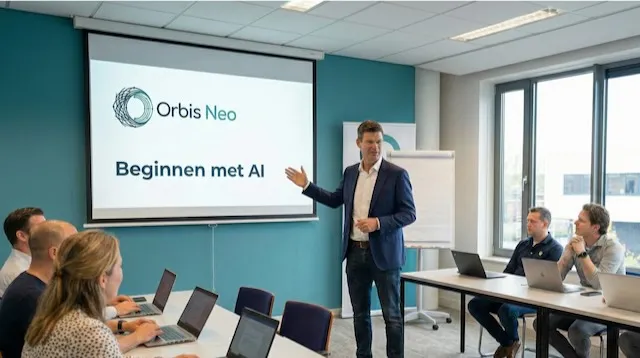
Starting an AI trial is often easier than deciding what it should prove. Consider a team that spends a great deal of time handling customer enquiries. Is the aim to draft replies faster, reduce handovers or improve accuracy? Each objective calls for a different trial and a different measure of success.
Leadership teams need to settle those questions early. What should improve, who is responsible, and what evidence would justify continuing?
More than a choice of tools
Many leadership teams approach AI as a technology issue and talk mainly about tools, suppliers and how quickly they can start. Choosing an AI application often also changes how work, responsibility and cost are distributed. That includes:
- the way work is carried out
- who is responsible for what
- cost and productivity
- risk, compliance and reputation
If you start with tools before answering these questions, it is often unclear afterwards what the tool was meant to solve.
Three reasons why AI initiatives get stuck in the management team
1. There is no shared definition of the problem
Within management teams, there are often different views of what AI is supposed to achieve. One person sees cost savings, another sees innovation, a third sees “something we cannot afford to miss”. Without an explicit choice, AI remains a catch-all concept, and nobody has the mandate to set priorities and make a decision. The result is separate initiatives competing for time and attention.
2. AI is treated separately from existing processes
AI is introduced as something new on top of the organisation, while the benefit usually lies in existing bottlenecks such as decision-making, handovers, administrative burden and reporting. If those processes are not understood first, AI mostly adds complexity. The tools then never become part of the team’s work.
3. Nobody has a clear mandate to decide
AI is often “assigned” to IT, innovation or data. But decisions about work, risk and human behaviour belong in the management team. Without a named decision-maker with the authority to act, people hold back and decisions are deferred. Pilots are not extended, and experiments end without a decision.
Three questions before the trial
Start with three questions:
- Which task or decision should improve, and how is it handled today?
- Who will assess the change, and what evidence will they use?
- Which errors or adverse effects would make us change or stop the trial?
Use the answers to select one initial application. Then work with the people doing the job and the IT team to assess what is feasible. AI may be useful; a change to the process or existing software may be enough.
What the first discussion should produce
I want that discussion to produce a decision: which application will we investigate, who will lead it and what must the trial demonstrate? The team also needs boundaries for data use and a clear plan for reviewing the results. That gives people a basis for the next step and gives management something concrete to assess.